

Marine life in Zeeland · Common cuttlefish · Spawning behaviour · Sepia Project · Diving at the Zeelandbrug
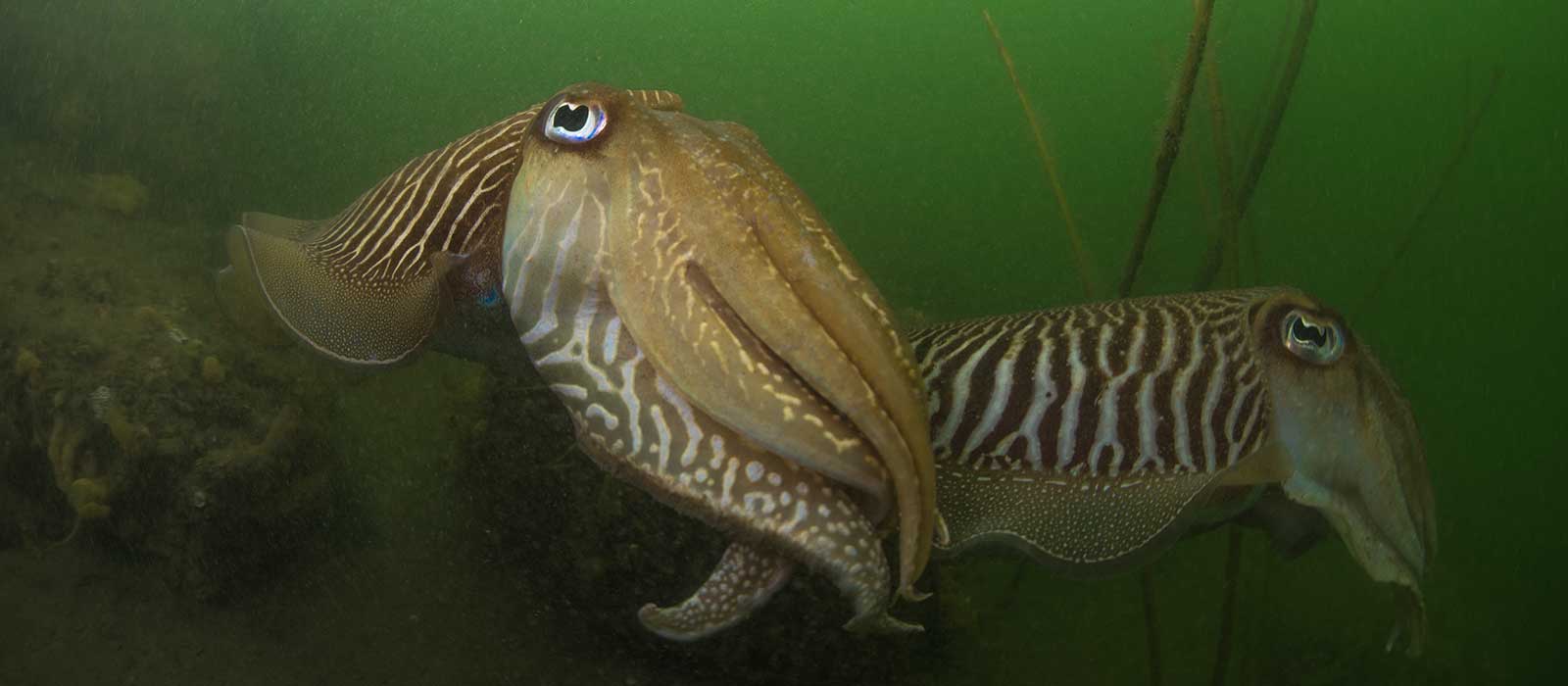
Every spring, one of the most impressive natural spectacles the Zeeland underwater world has to offer takes place in the Oosterschelde. The common cuttlefish (Sepia officinalis) - known among divers simply as sepia - migrates from the North Sea to the shallows of the Zeeland Delta to spawn. For many divers, this is the highlight of the season.
What is a common cuttlefish?
The common cuttlefish is a ten-armed cephalopod that can grow to forty to fifty centimetres in length. Outside the spawning season, it lives a solitary and secretive life, but in spring that changes completely: the cuttlefish becomes colourful, curious and surprisingly approachable. They communicate with one another through rapid colour and pattern changes across their skin: from calm brown to vivid zebra displays. They are intelligent, agile and remarkably easy to observe up close.
The cuttlefish is a short-lived species. The animals reach the age of two, make a single migration to their spawning grounds in spring, and die shortly afterwards. They do everything once and with remarkable intensity.
When are cuttlefish present in the Oosterschelde?
Once the water temperature in the Oosterschelde reaches around twelve degrees Celsius, the first cuttlefish appear. This is typically late April or early May. Once one has passed through the Oosterschelde storm surge barrier, many more quickly follow. The spawning period lasts an average of eight weeks. The best chance of good sightings is before mid-June.
Where can you see cuttlefish in Zeeland?
During the spawning season, cuttlefish can be encountered throughout the Oosterschelde. One of the best dive sites to find them is the Zeelandbrug - also the first location where so-called sepia tents were ever placed, and where divers continue to do so today. Zoetersbout is another well-known spot. During the spawning period the animals are abundant and barely disturbed by divers.
How do cuttlefish spawn?
The spawning behaviour of the common cuttlefish is remarkable to witness. Males seek out females as soon as they arrive and guard them actively. Rival males are kept at bay through intense colour displays and sometimes outright fights, occasionally accompanied by large clouds of ink.
The female selects carefully and deposits her eggs in black, grape-shaped clusters attached to hard substrates. A single egg string can contain a hundred tiny cuttlefish. After six weeks the eggs hatch. Shortly afterwards the adults die. The cuttlefish makes its spawning migration only once.
The Sepia Project: how divers have been making a difference for 30 years
In 1996, sport divers Felice and Joop Stalenburg launched the initiative that would become known as the Sepia Project. They observed that cuttlefish were becoming trapped en masse in lobster traps instead of laying their eggs. Their solution: tents made of plane tree branches placed on the seabed near the Zeelandbrug, mimicking the attraction of the traps.
It worked immediately. Cuttlefish began laying their eggs on the branches. At its peak, five thousand branches were placed each season. Joop observed as many as a hundred cuttlefish in a single dive in the late nineties. The tents also became home to squid, bobtail squid and short-snouted seahorses (Hippocampus hippocampus).
In 2007 Felice and Joop won the AD Nature Prize. They later received an honorary award from the Dutch Underwater Sports Federation for over 25 years of dedication to the Oosterschelde's marine environment. Since then, other divers have followed their example — tents are now placed annually at various dive sites throughout the Oosterschelde and occasionally in the Grevelingen as well.
Why is the cuttlefish population declining?
The cuttlefish population in the Oosterschelde has declined significantly over the past few decades. Where a hundred animals per dive was not uncommon in the late nineties, today only a handful may be seen. Possible causes include:
- Bycatch in lobster traps during the spawning season: cuttlefish swim into traps and cannot get out
- Climate change and shifts in water temperature and food availability
- Growing seal populations in the Oosterschelde
- Loss of suitable habitat due to changes in the seabed structure
The lobster trap problem has been known for years: while squid deposit their eggs on the outside of traps, cuttlefish swim inside. Once one enters, others follow.
Deltapark Neeltje Jans working towards population recovery
In September 2025, Deltapark Neeltje Jans took a concrete step: forty captive-bred young cuttlefish were released into the Oosterschelde. The animals are descendants of cuttlefish born and raised in the park's aquarium - an approach that generates scientific knowledge and contributes to population recovery.
"There is still so much to learn about these animals. What is happening here, you won't find anywhere else in the Netherlands," says Madelon van der Maas, head of animal care at Neeltje Jans.
Tips for divers: how to dive with cuttlefish
Cuttlefish are curious animals, but they require a calm approach. Practical tips:
- Move slowly and avoid sudden movements
- Keep your dive light steady, don't sweep it back and forth restlessly
- Keep your distance and let the cuttlefish come to you
- Look carefully around you: cuttlefish can appear suddenly from the dark, are excellent at camouflage and can even bury themselves in the sand
- Respect the animals: do not touch them and avoid disturbing spawning behaviour
A dive at the Zeelandbrug or Zoetersbout in May or June is an experience most divers will not quickly forget. We dive these locations regularly and would be happy to take you along.
Photo by Yoeri van Es Onderwaterfotografie.
